
This is one of my favorite books.
I highly recommend it.
Spartacus and the Slave Wars: A Brief History with Documents by Brent D. Shaw
Project 'Read a Book'
Spartacus, and, the, Slave, Wars, A, Brief, History, with, Documents, by, Brent, D. Shaw, History, Read, Book, List
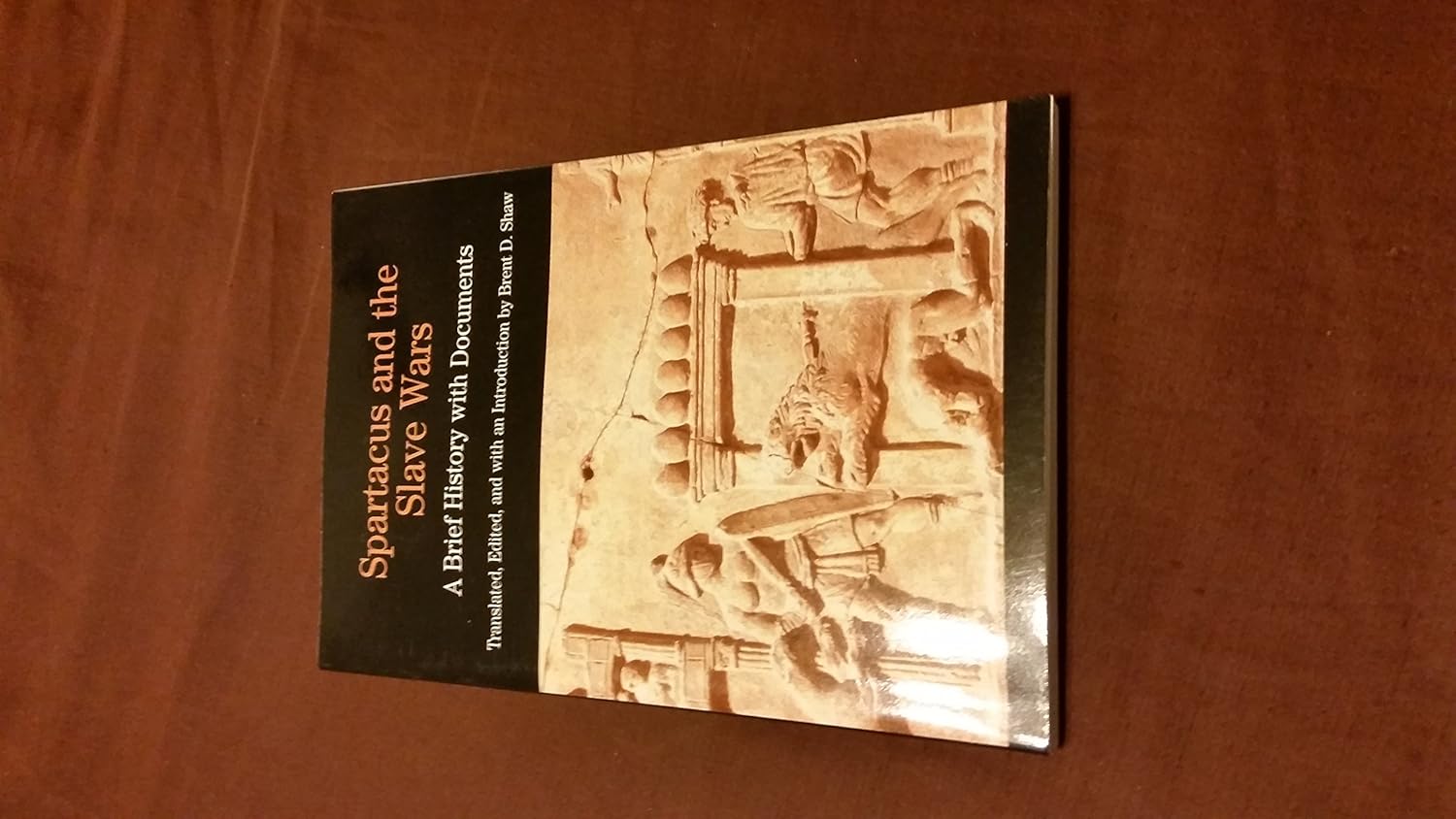
Spartacus and the Slave Wars: A Brief History with Documents by Brent D. Shaw
Spartacus and the Slave Wars: A Brief History with Documents by Brent D. Shaw
Summary of Spartacus and the Slave Wars: A Brief History with Documents
Spartacus and the Slave Wars: A Brief History with Documents (The Bedford Series in History and Culture): https://www.amazon.com/Spartacus-Slave-Wars-History-Documents/dp/0312183100
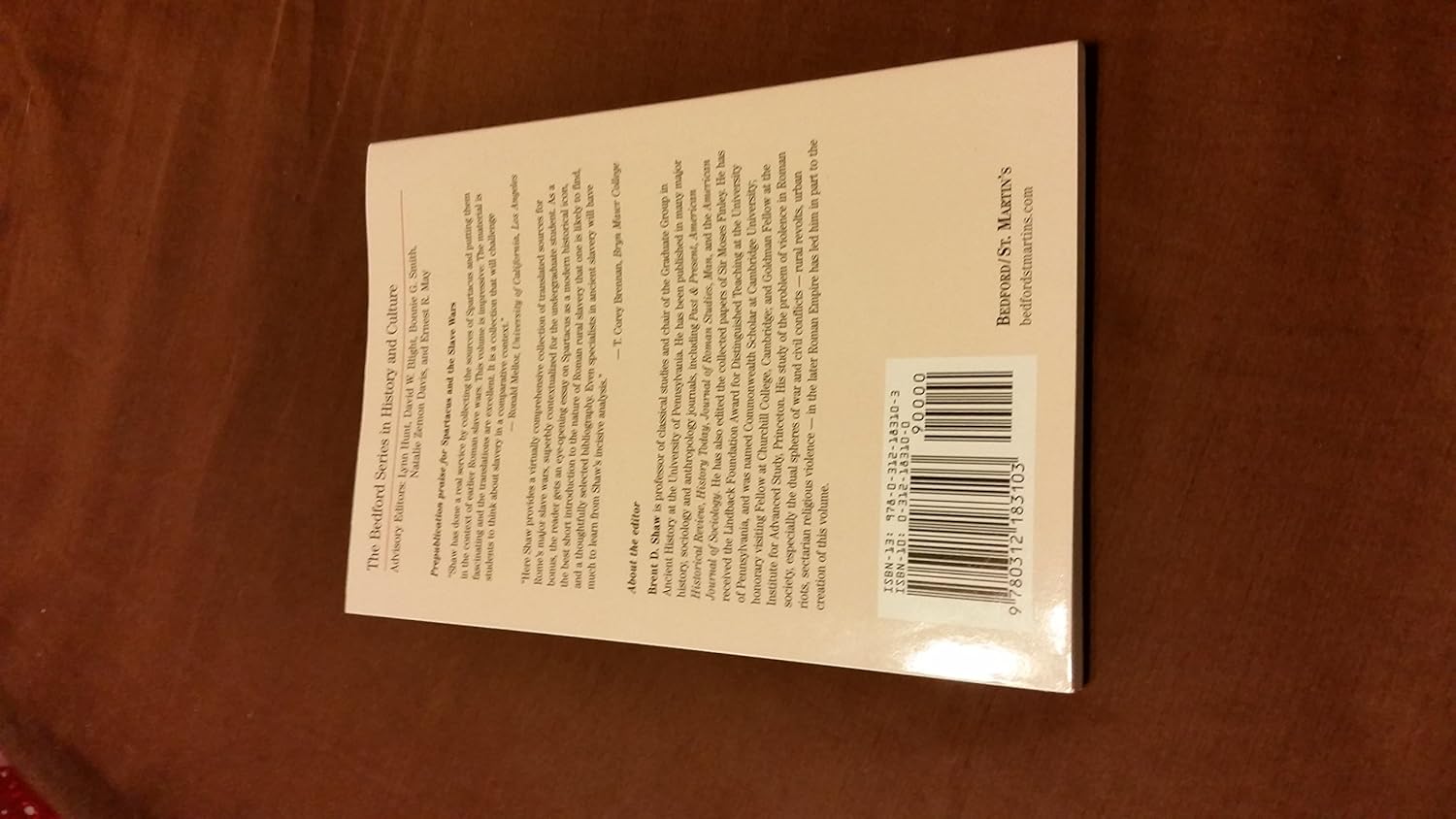
Brent D. Shaw's "Spartacus and the Slave Wars: A Brief History with Documents" is not a narrative retelling of the Spartacus story in the traditional sense.
Instead, it serves as a comprehensive scholarly examination of Roman slavery and slave revolts, with a particular focus on the Third Servile War led by Spartacus. The "story" it tells is largely through the lens of primary source documents translated from Greek and Latin, accompanied by Shaw's expert analysis and contextualization.
1. The Broader Context of Roman Slavery
Shaw emphasizes that the Spartacus rebellion was not an isolated incident but the culmination of a widespread and brutal system of slavery that was fundamental to the Roman economy and society, particularly in Italy and Sicily. He dedicates significant portions of the book to:
Daily Life of Slaves
The book presents documents illustrating the harsh realities of slave life, especially for those working on large agricultural estates (latifundia) in Italy and Sicily, and the specialized world of gladiators.
Forms of Resistance
Beyond large-scale revolts, Shaw highlights other forms of slave resistance, such as running away (forming "maroon communities"), sabotage, and individual acts of defiance.
Previous Slave Wars
Crucially, Shaw details the two earlier Sicilian Slave Wars (135–132 BCE and 104–100 BCE), demonstrating that slave rebellions were a recurring threat to Roman authority. These earlier revolts set the stage for understanding the conditions that led to Spartacus's uprising.
2. The Spark of the Spartacus Revolt (73 BCE)
The book zeroes in on the direct origins of the Third Servile War
Gladiatorial School at Capua
The rebellion began with an escape from a gladiatorial training school owned by Lentulus Batiatus in Capua. Spartacus, a Thracian gladiator, along with about 70 fellow gladiators, broke free, arming themselves with kitchen utensils before seizing proper weapons.
Early Victories and Growth
The escaped slaves initially defeated local Roman forces sent to suppress them and quickly attracted a growing number of runaway slaves, including many agricultural laborers from the surrounding countryside. They established a defensible position on Mount Vesuvius.
Leadership
Spartacus, along with other leaders like Crixus and Oenomaus (though Roman sources often focus predominantly on Spartacus), emerged as capable military commanders.
3. The Course of the War (73-71 BCE)
Shaw's presentation of the war itself relies heavily on ancient historians like Appian, Plutarch, and Livy.
Early Successes
The slave army, demonstrating remarkable tactical skill and discipline, repeatedly defeated hastily assembled Roman militias and even regular legions. They plundered Roman estates and towns, amassing resources and further swelling their ranks.
Internal Divisions
The sources hint at disagreements among the rebel leaders. Crixus and a contingent of Gauls and Germans reportedly broke off from Spartacus's main force, preferring to continue plundering southern Italy, while Spartacus seemingly aimed to lead his followers out of Italy to freedom. This division ultimately weakened the rebellion.
Roman Response
The Roman Republic initially underestimated the threat, viewing it more as a policing matter than a full-scale war. However, as the slave army grew and achieved significant victories, Rome was forced to commit more substantial military resources.
Marcus Licinius Crassus
The decisive figure in suppressing the revolt was Marcus Licinius Crassus, a wealthy and ambitious Roman senator. He was given extraordinary powers and commanded a large army (eventually eight legions, approximately 40,000 men). Crassus implemented harsh discipline within his own ranks and strategically cornered Spartacus's forces in Calabria.
Betrayal by Pirates (alleged)
Plutarch mentions an attempt by Spartacus to secure passage to Sicily with Cilician pirates to ignite another slave revolt there, but the pirates allegedly betrayed him, taking payment and abandoning the rebels.
Final Battle
The climactic battle took place in Lucania (southern Italy). Despite their bravery, the slave army was ultimately overwhelmed by Crassus's superior forces. Spartacus himself is said to have fought valiantly to the end, dying on the battlefield.
Crucifixions
In a gruesome display of Roman power and a deterrent against future revolts, Crassus ordered the crucifixion of 6,000 captured rebels along the Appian Way from Capua to Rome.
4. Motives and Legacy of Spartacus
Shaw's analysis delves into the enduring questions surrounding Spartacus
Objectives
The ancient sources offer differing accounts of Spartacus's ultimate goals. Some suggest he simply wanted to lead his followers to freedom and return them to their homelands, while others hint at a broader ambition to challenge the Roman system. Shaw critically examines these interpretations, acknowledging the limitations and biases of the Roman historical record.
Symbol of Rebellion
The book explores why Spartacus has remained such a potent symbol of resistance against oppression throughout history, influencing various political and social movements, from ancient times to modern interpretations in literature and film. Shaw highlights how different eras have projected their own ideals onto the figure of Spartacus.
Overall, "Spartacus and the Slave Wars" is less about a flowing narrative and more about:
Presenting the fragmented and often biased ancient evidence.
Shaw's main contribution is to bring together these diverse sources and provide a framework for understanding them.
Contextualizing the Spartacus revolt within the larger history of Roman slavery and resistance.
Encouraging readers to critically analyze historical sources and draw their own conclusions about the events and the motivations of those involved.
By focusing on the documents themselves, Shaw allows the reader to engage directly with the primary accounts that form our understanding of Spartacus and the brutal world of Roman slavery.
Brent D. Shaw's "Spartacus and the Slave Wars" is a historical analysis with a strong emphasis on primary source documents.
\
Favorite Characters
Spartacus (Thracian Gladiator)
The central figure of the Third Servile War (73-71 BCE).
A Thracian, possibly a former auxiliary soldier, who was enslaved and sold to Lentulus Batiatus' gladiatorial school in Capua.
He led the initial escape with fellow gladiators and quickly proved to be a brilliant military strategist and charismatic leader. He sought to lead his followers out of Italy to freedom.
Ancient sources generally describe him as intelligent, courageous, and humane for a slave leader, though their accounts are often biased and colored by Roman perspectives. Shaw's book highlights the various interpretations of his motives and ultimate goals.
Crixus (Gallic Gladiator)
One of the initial leaders alongside Spartacus and Oenomaus. He commanded a significant contingent of Gauls and Germans.
According to some sources, Crixus advocated for continued plunder in Italy rather than Spartacus's apparent goal of escaping the peninsula. This disagreement led to a split in the rebel forces.
Crixus and his forces were ultimately defeated and killed by Roman legions under the command of Quintus Arrius near Mount Garganus.
Oenomaus (Gallic Gladiator)
Another early leader of the escaped gladiators, alongside Spartacus and Crixus.
His presence in the historical record is less detailed than Crixus's. He is believed to have died early in the revolt.
Eunus (King Antiochus) (Syrian Slave)
The leader of the First Sicilian Slave War (135-132 BCE).
A Syrian slave from Apamea, owned by Antigenes in Enna, Sicily. He was a self-proclaimed prophet and magician.
He initiated the revolt in Sicily, promising his followers divine guidance. He adopted the royal name "Antiochus" and established a kingdom of sorts for the rebelling slaves.
Shaw uses Eunus's story to illustrate the nature of earlier slave revolts and their leadership, providing crucial context for understanding Spartacus.
Kleon (Cilician Slave)
Co-leader of the First Sicilian Slave War with Eunus.
A Cilician who had experience as a bandit and herdsman.
He led a separate group of rebelling slaves in Sicily, eventually joining forces with Eunus.
Salvius (King Tryphon) (Greek Slave)
Leader of the Second Sicilian Slave War (104-100 BCE).
A Greek slave with a reputation for divination and flute-playing.
He led the revolt from the western side of Sicily, later adopting the royal name "Tryphon."
Athenion (Cilician Slave)
Co-leader of the Second Sicilian Slave War with Salvius.
A Cilician with organizational skills and a reputation for astromancy.
Initially Salvius's subordinate, he took over leadership after Salvius's death.
Marcus Licinius Crassus
The most prominent Roman figure in the book, as he was the general ultimately responsible for defeating Spartacus.
One of the wealthiest men in Rome, with significant political ambitions.
Appointed by the Senate to suppress the Spartacus revolt after several other Roman commanders failed. He employed harsh discipline (including decimation) to motivate his troops and ultimately cornered and defeated Spartacus.
Gaius Cassius Longinus
A Roman consul who was defeated by Spartacus's forces early in the Third Servile War. His defeat highlighted the seriousness of the slave rebellion.
Gnaeus Manlius
A Roman praetor who was also defeated by Spartacus's forces.
Publius Varinius
Another Roman praetor who suffered defeats at the hands of Spartacus.
Gnaeus Pompey Magnus (Pompey the Great)
A powerful Roman general who returned from Spain (where he was fighting Sertorius) at the end of the Spartacus War. While Crassus delivered the decisive blow, Pompey's arrival and his subsequent mopping-up operations (he captured many escaped rebels and claimed some credit for ending the war) became a point of contention between him and Crassus.
Lucius Cornelius Sulla
Though not directly involved in the Spartacus War itself, Sulla's proscriptions and the social upheaval he caused are often mentioned as contributing to the conditions that made such a large-scale slave revolt possible. Shaw's introductory essays often touch upon the political climate in Rome preceding the war.
Lentulus Batiatus
The owner of the gladiatorial school in Capua from which Spartacus and his companions escaped. He represents the system that bred and exploited gladiators.
Appian
A Greek historian who wrote during the Roman Empire. His account of the Servile Wars is one of the most detailed and frequently cited sources.
Plutarch
A Greek biographer and historian, known for his "Parallel Lives." His biography of Crassus provides significant information about Spartacus.
Sallust
A Roman historian and politician. His works offer some insights into the Roman perspective on the slave wars.
Livy
A Roman historian whose monumental "Ab Urbe Condita" (History of Rome from its Foundation) provides brief summaries of the slave wars.
Diodorus Siculus
A Greek historian who preserved detailed accounts of the Sicilian Slave Wars, making him crucial for understanding the context of earlier revolts.
Florus
A Roman historian who provided a concise, rhetorical overview of Roman history, including the slave wars.
Frontinus
A Roman engineer and writer, known for his work on military stratagems, some of which attribute clever tactics to Spartacus.
Enduring lessons
The Brutality and Centrality of Roman Slavery
The book vividly demonstrates that Roman society, particularly in the late Republic, was fundamentally built upon a system of widespread and often brutal chattel slavery. This wasn't a peripheral aspect but a core engine of the economy and a constant source of social tension. The revolts, therefore, were not anomalies but inevitable reactions to systemic oppression.
The Fragility of Order in a Slave Society
Despite Rome's immense military power and sophisticated administration, the slave revolts, particularly the one led by Spartacus, exposed the inherent instability of a society reliant on enslaved labor. The fear of slave uprisings was a constant undertone in Roman aristocratic thought, and the sheer scale and longevity of the Third Servile War deeply rattled the Roman elite.
The Power of Collective Resistance, Even Against Overwhelming Odds
Spartacus's revolt, though ultimately crushed, showed that even the most oppressed groups could organize, fight, and achieve remarkable successes against a seemingly invincible power. Their early victories, strategic maneuvers, and ability to attract tens of thousands of followers highlight the potent force of collective action fueled by a desire for freedom.
The Limitations of Slave Revolts in the Ancient World
While inspiring, the book also underscores the immense challenges faced by slave revolts. Lacking widespread external support, facing a highly organized and ruthless Roman military machine, and often hampered by internal divisions (as seen with Crixus), these rebellions were ultimately unsustainable in the long term. Shaw emphasizes the rarity of truly successful, large-scale slave rebellions throughout history, not just in Rome.
The Bias of Historical Sources
A crucial lesson Shaw imparts is the importance of critically analyzing primary sources. Since virtually all surviving accounts of Spartacus and the slave wars come from Roman writers (the victors), they are inherently biased. They portray the slaves as bandits or dangerous criminals and often diminish their leaders' abilities or motivations. Shaw forces the reader to confront this bias and consider what might be missing or distorted in the historical record.
The Enduring Symbolism of Spartacus
The book explains why Spartacus has persisted as a powerful symbol of resistance, freedom, and class struggle across centuries and cultures. Despite the limited and biased historical evidence, his story has been adapted and reinterpreted by various movements (from abolitionists to socialists) to suit their own struggles against oppression. This demonstrates the fluid and adaptable nature of historical memory and its role in shaping political and social discourse.
The "Invisibility" of the Enslaved
Shaw's use of diverse documents, beyond just the narratives of the wars, helps to shed light on the mundane and brutal realities of daily life for Roman slaves. This includes the laws governing them, their work on farms, and their training as gladiators. By doing so, the book makes the otherwise "invisible" enslaved population more tangible and underscores the systemic nature of their dehumanization.
"The historical Spartacus remains elusive, largely a construct of the Roman victors' pens and the later projections of those who have sought in him a timeless symbol of resistance against oppression."
About the Project
Project 'Read a Book'

Project 'Read a Book'
Reading a full book is beneficial because it fosters deep focus, critical thinking, and emotional stability, unlike the fragmented information often consumed in short bursts online.
Immersing oneself in a book enhances cognitive functions such as comprehension, memory, and empathy by encouraging readers to engage with complex narratives, diverse perspectives, and sustained storylines.
It also provides a sense of accomplishment and mental clarity, allowing individuals to disconnect from daily stress and build a more reflective, informed worldview.
See you in the next one!
If you wish to support our project
Donation link (Buy me a coffee):