
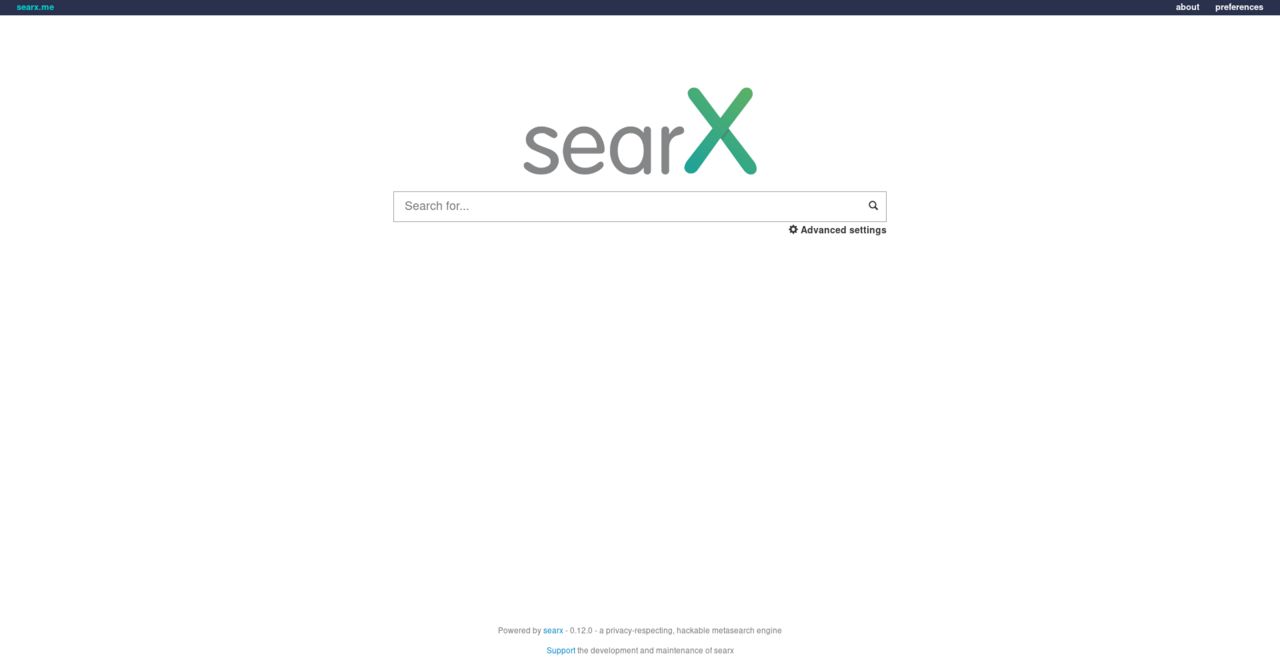
Searx is a metasearch engine
That means it doesn’t crawl the web itself like Google and instead, it sends our query to many other search engines and aggregates their results.
It is free and open-source, under the GNU Affero General Public License v3.
It was designed with privacy as a top priority.
Searx does not share our IP address or search history with the search engines it queries.
It blocks tracking cookies from third-party search engines, which reduces profiling based on our searches.
By default, Searx sends search requests using HTTP POST. This is to avoid having our search terms appear in web server logs.
For each result it shows:
A direct link to the original site (not a tracking redirect).
Optionally, a cached version via the Wayback Machine, or a proxied version (so we can view the page through Searx without going to the original site directly).
Searx supports different “tabs” or categories:* general web,
* images,
* maps,
* music,
* news,
* science,
* social media,
* videos, and more.
We can choose which search engines Searx uses for our queries.
It supports a large number (around 82) of engines, including Google, Bing, Wikipedia, Reddit, Yandex, etc.
We can control search behavior by using search operators:
!engine or ?engine to force or include specific upstream engines
!category or ?category to choose specific categories
:language to pick a language for results
Settings (like which engines we use or categories) are stored in a browser cookie, not on a Searx server (because Searx doesn’t use user accounts).
Anyone can run their own Searx instance on their server or computer.
Benefits of a self-hosted instance:
* More privacy (our Searx instance is the one talking to other search engines)
* We can customize it a lot — even add search engines that public instances don’t use.
* We avoid relying on public, third-party Searx servers.
* There are also many public Searx instances run by different people, some even as Tor hidden services.
According to Wikipedia, the original Searx project is discontinued (its GitHub repository has been archived as of September 2023).
There is a successor / fork called SearXNG, which continues development.
SearXNG supports many of the same ideas (privacy, metasearch) but has more active maintenance, bug fixes, and improvements.
Advantages:
* Much more private than mainstream search engines.
* No user profiling: since Searx doesn’t build a profile, we are less likely to get “filter bubble” effects.
* Very customizable: we choose which upstream engines to query, which categories to search.
* Open-source: we (or anyone) can inspect the code.
* Because it's aggregating from many engines, result quality and relevance might be more unpredictable than Google.
* Running your own instance
* If we care about privacy and don’t want a search engine to keep a detailed profile
Enjoy #linux 🐧
Well, that was exciting. See you in the next one!