
This is one of my favorite books.
I highly recommend it.
Morality Play by Barry Unsworth
Project 'Read a Book'
Morality, Play, Barry, Unsworth, novel, Project, Read, Book, List
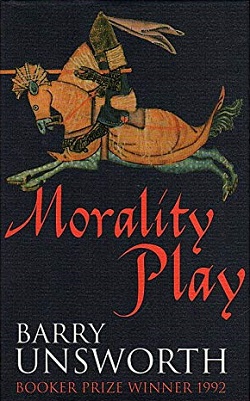
Morality Play by Barry Unsworth
Morality Play by Barry Unsworth
Summary of Morality Play
Morality Play: https://en.wikipedia.org/wiki/Morality_Play_(novel)
Barry Unsworth's "Morality Play" is a highly acclaimed historical novel set in 14th-century England. It was shortlisted for the Booker Prize in 1995.
The story follows Nicholas Barber, a young priest who, fleeing his diocese due to personal sins, falls in with a raggedy troupe of traveling players. They are on their way to perform for a liege lord at Christmas, but financial difficulties force them to stop in a small, unnamed village in Northern England.
Upon arriving, they discover the village is in an uproar over the recent murder of a young boy, Thomas Wells, for which a deaf-mute woman, Jane, has been accused and is set to be hanged. Desperate for money and a way to attract an audience, the troupe's leader, Martin, has a radical idea: instead of performing their usual biblical morality plays, they will stage a play based on the real-life murder.
Initially, the play is conceived to simply re-enact the commonly accepted version of events. However, as the actors begin to research and gather details from the villagers, they start to uncover inconsistencies and disturbing facts that contradict the official story. The line between their "play" and reality blurs, and they realize that the accused woman may be innocent. Their theatrical investigation gradually unearths a deeper conspiracy involving the local feudal lord, Richard de Guise, and a corrupt monk.
They refine their play, incorporating newly discovered facts, essentially using their art to conduct a forensic investigation.
Through their inquiries, they uncover a darker, more complex truth.
The real murderer is William de Guise, the lord's son.
The monk, Simon Damian, is complicit. He discovered William's crime but, to protect the powerful de Guise family and enrich himself, he framed Jane. He orchestrated the hasty trial and conviction to silence any further investigation.
Lord de Guise is fully aware of his son's crime and the cover-up. He wields his immense power to suppress the truth and maintain his family's reputation and authority.
As the players' "True Play of Thomas Wells" draws closer to the actual events, they face increasing danger. Their performances, rather than simply entertaining, expose the corruption and injustice perpetrated by the local lord and his monk. The villagers, initially captivated by the spectacle, begin to grasp the deeper implications.
The monk, Simon Damian, is found hanged – an apparent suicide, but the players suspect foul play, possibly orchestrated by Lord de Guise to silence a dangerous loose end.
Lord de Guise, realizing the threat the players pose to his carefully constructed façade, summons them to his castle. He forces them to perform their "truthful" play for him, hoping to control the narrative or silence them permanently.
During this private performance at the castle, the full horror of William's crimes and the extent of his father's cover-up are laid bare. It's revealed that William is not just a murderer and abuser, but also suffering from the plague, which he contracted from one of his victims. The smell of the plague-infected room within the castle confirms this.
The situation is incredibly tense, but a King's Justice, Sir Roger of Yarm, arrives in the village, on a separate mission to investigate Lord de Guise's other corrupt practices. Nicholas, through his previous life as a clerk and his quick thinking, manages to make contact with the King's Justice and subtly convey the players' findings. The Justice, already suspicious of de Guise, orders the exhumation of Thomas Wells's body, confirming the signs of sodomy and the early stages of plague. This corroborates the players' "truth."
William de Guise, his depravity exposed and his illness undeniable, faces a grim fate. Lord de Guise's power is diminished, and he is publicly disgraced. Jane is set free.
The players, having risked everything for the truth, depart the village. Nicholas has found a new purpose, a different kind of "morality" than the one he fled from. He has witnessed the redemptive power of truth and art, even in a brutal world. The novel ends with the players continuing their journey, leaving the chaos behind but carrying the weight and meaning of their extraordinary "morality play." Nicholas, though still a runaway priest, has found a different kind of salvation through his commitment to justice and his newfound community of players.
The story doesn't offer a clean, tidy ending, but rather a profound reflection on the enduring struggle between truth and power in a morally ambiguous world.
Favorite Characters
Nicholas Barber
The protagonist and narrator. Nicholas is a young, intelligent, and literate former priest who has fled his diocese after breaking his vows (implied to be related to a sexual transgression and possible violence towards his superior). He is guilt-ridden, questioning his faith and purpose. He is initially an outsider to the acting troupe but gradually becomes integral to their investigative efforts, using his sharp mind and education to piece together clues. His journey is one of moral redemption and finding a new calling, not in the church, but in the pursuit of truth through art.
Martin Ball
The charismatic, audacious, and often volatile leader of the acting troupe. Martin is a visionary, unafraid to challenge conventions. It is his radical idea to perform a "play" based on the recent murder of Thomas Wells, thereby turning their theatrical art into a means of uncovering truth and justice. He is driven by a mix of artistic ambition, a shrewd understanding of human nature, and a growing sense of outrage at injustice. He's a complex figure – sometimes pragmatic and calculating, other times passionately idealistic.
Tobias
The oldest member of the troupe, Tobias is a wise, experienced, and steady presence. He often serves as a voice of caution and reason, grounded in the realities of their harsh world. He has seen much and understands the dangers they face. He's a skilled actor, particularly in the traditional morality plays, and often provides the historical and practical counterpoint to Martin's more impulsive ideas.
Stephen
A former archer, recognizable by a missing thumb. Stephen is pragmatic, loyal, and often wary of the risks Martin takes. He's a man of action and a good fighter, providing a physical element to the troupe's defense when needed. He is deeply devoted to Margaret.
Springer
The youngest member of the troupe, who often plays the female roles due to his youth and slight build. Springer is eager to learn and often innocent in his perspective, providing a foil to the cynicism of the older players.
Straw
Another member of the troupe, sometimes prone to mood swings and less articulate than the others. He is a steadfast but less prominent member of the group, contributing to their collective efforts.
Margaret
Stephen's woman, she travels with the troupe, managing their costumes, props, and often their meager finances. She is a practical, resilient, and no-nonsense woman, who provides a grounded perspective and ensures the daily necessities are met.
Brendan
A member of the troupe who dies just before Nicholas joins. His death (implied to be from plague) creates the vacancy that Nicholas fills, setting the stage for the novel's events. He represents the ever-present threat of disease and the precariousness of their lives.
Thomas Wells
The young boy whose brutal murder ignites the central mystery of the novel. His death is the catalyst for the players' "investigation" and the unfolding of the dark secrets within the village.
Jack Flint
A local carpenter in the village. He is one of the villagers interviewed by the players as they research the murder. He provides some initial, seemingly straightforward information about the crime and the accused.
Jane
The deaf-mute woman accused and condemned for the murder of Thomas Wells. She is an outcast, vulnerable, and an easy target for those seeking a scapegoat. Her inability to speak makes her particularly helpless against the rigged justice system. Her innocence is the driving force behind the players' pursuit of the truth.
John Lamber
A farmer in the village. He also provides testimony or information to the players during their inquiries, often reflecting the commonly held beliefs or fears of the villagers.
Lord Richard de Guise
The local feudal lord, a powerful and ruthless man who holds absolute sway over the village and its inhabitants. He is deeply involved in the cover-up of his son's crime, prioritizing his family's reputation and power over justice. He embodies the corruption and arbitrary authority of the medieval nobility.
William de Guise
Lord de Guise's son. He is the true murderer of Thomas Wells. William is depicted as depraved, cruel, and ultimately, a victim of his own unchecked urges and, as revealed later, the plague he contracts from his victims. He represents the dark side of inherited power and moral decay.
Simon Damian
A corrupt Benedictine monk who serves Lord de Guise. He is the architect of the frame-up against Jane, planting evidence and manipulating the legal process to protect William de Guise and secure his own position and wealth. He embodies the corruption within the Church at the time.
The King's Justice / Sir Roger of Yarm
An agent of the King's authority, sent to investigate other matters of corruption concerning Lord de Guise. He appears late in the novel, but his arrival proves crucial. Nicholas is able to subtly communicate the players' findings to him, leading to the exhumation of Thomas Wells's body and the ultimate exposure of William de Guise's crime and his father's cover-up. He represents a higher, albeit sometimes slow, form of justice that can occasionally cut through local corruption.
Enduring lessons
Truth is not always what is presented, and often requires active pursuit
The most central lesson is that official narratives, especially those backed by power, are not always the truth. The players initially believe the official story of Jane's guilt but, through their "play," they are forced to question it. The book demonstrates that uncovering truth requires diligent investigation, critical thinking, and a willingness to challenge accepted versions of events, even when it's dangerous.
Art and Storytelling have the power to reveal and challenge injustice
The novel powerfully illustrates how drama, far from being mere entertainment, can be a potent tool for social commentary, investigation, and even justice. The "Play of Thomas Wells" becomes a medium through which uncomfortable truths are brought to light, forcing both the characters and the audience to confront the moral failings of their society. It shows that storytelling can illuminate hidden realities and stir consciences.
Justice can be elusive, and often requires courage and sacrifice
In a world where power dictates right and wrong, true justice is hard-won. The players put their lives at risk to expose the truth and free an innocent woman. The book underscores that fighting for justice, particularly against entrenched corruption, demands immense courage and a willingness to face severe consequences.
Moral corruption can permeate all levels of society
From the local lord to the seemingly devout monk, "Morality Play" exposes how power can corrupt. Lord de Guise's willingness to protect his depraved son at any cost, and Simon Damian's complicity in framing an innocent woman for personal gain, illustrate the pervasive nature of moral decay when unchecked authority is present.
Outsiders can sometimes see the truth more clearly
The traveling players are outsiders, vagrants on the fringes of society. This outsider status paradoxically gives them a unique perspective, free from the local biases, fears, and obligations that blind the villagers. They are not beholden to the local power structure, allowing them to pursue the truth without the same constraints.
Redemption can be found in unexpected places
Nicholas Barber, a disgraced priest burdened by his past sins, finds a path to redemption not by returning to the church, but by engaging with the world and fighting for justice alongside the players. His journey suggests that true morality lies in action and integrity, rather than strict adherence to dogma or outward appearances.
The vulnerability of the powerless in the face of authority
Jane, the deaf-mute woman, represents the ultimate victim of a system designed to protect the powerful. Her inability to speak, her low social status, and the prevailing superstitions of the time make her an easy scapegoat. The book highlights the profound injustice faced by those without voice or power.
The enduring human need for meaning and purpose
Nicholas, initially aimless and despairing, finds a new sense of purpose in the pursuit of truth with the players. This speaks to a fundamental human need to contribute to something greater than oneself, even in the most challenging circumstances.
"I knew little of the world, as the Justice had seen, but I knew that we can lose ourselves in the parts we play and if this continues too long we will not find our way back again."
Nicholas Barber's reflections on the nature of acting, truth, and identity
About the Project
Project 'Read a Book'

Project 'Read a Book'
Reading a full book is beneficial because it fosters deep focus, critical thinking, and emotional stability, unlike the fragmented information often consumed in short bursts online.
Immersing oneself in a book enhances cognitive functions such as comprehension, memory, and empathy by encouraging readers to engage with complex narratives, diverse perspectives, and sustained storylines.
It also provides a sense of accomplishment and mental clarity, allowing individuals to disconnect from daily stress and build a more reflective, informed worldview.
See you in the next one!
If you wish to support our project
Donation link (Buy me a coffee):