
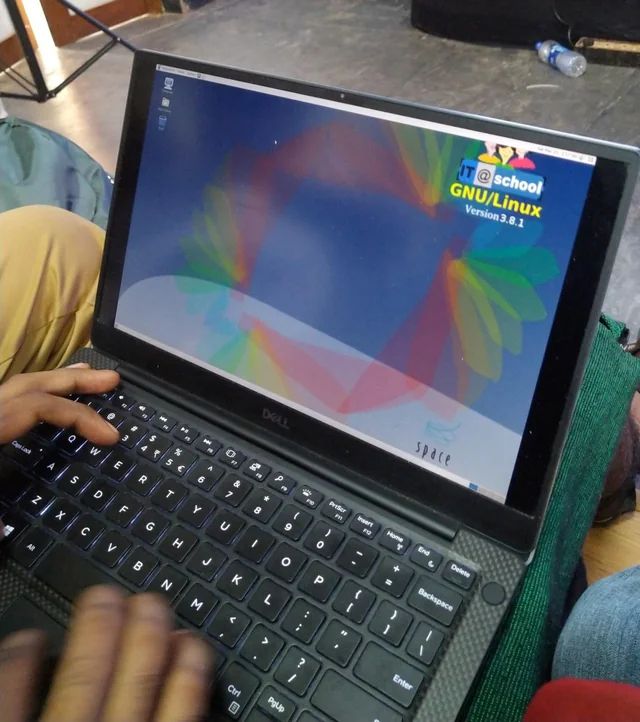
KITE GNU Linux
According to KITE’s own reports, their Hi-Tech School Project has upgraded 45,000 classrooms in 4,752 secondary schools.
According to their 2022–23 RTI report, KITE supports 16,026 schools with its infrastructure.
They also report having provided 450,000+ ICT devices overall across schools.
In February 2025, KITE distributed 29,000 robotic kits (Arduino-based) to high schools to give hands-on exposure to robotics, IoT, and AI.
They’re also planning to build a state-owned AI engine for schools under KITE.
KITE reportedly trained 80,000 teachers in AI fundamentals.
This is tied into a broader AI-enabled classroom push: KITE describes a global model for technology-driven education in Kerala.
The cost savings from using FOSS (free and open-source software) continue to be a big selling point. The switch to KITE GNU Linux saved a large sum for the government.
The OS suite (KITE GNU Linux) is not just for school machines: it's also made available for teachers, students, government offices, DTP centers, etc.
KITE GNU Linux is meant for 300,000 computers.
It uses Wayland (a modern display server) now, which is more performant/modern than the older Xorg system.
It includes a wide variety of educational software (animation, graphics, AI-teaching tools, etc.).
It supports Malayalam computing and includes tools for DTP, 3D animation, video editing, etc.
A study by the National Law School of India (NLSIU) recognized KITE as one of the only two government entities in India that are “successful FOSS implementers.”
This means KITE’s model is being looked at as a real example for FOSS in education, not just a niche project.
The large number of robotic kits plus teacher training plus AI curriculum shows that this is about modern, future-focused education.
And Linux is making it happen.
Because it's open-source, KITE can maintain and update its OS without licensing costs. This helps with long-term sustainability.
Support for Malayalam and tools for content creation make the OS very usable in the local context.
The continued emphasis on saving government money (vs proprietary software) is compelling.
Keeping a custom OS updated (security, compatibility) for so many machines is non-trivial.
Some school computers might be older or low-spec, which could limit how well more demanding apps (3D, animation, AI tools) run.
While many teachers are being trained, scaling that training effectively to ensure good pedagogy and support could be hard.
KITE’s work continues, and they’re expanding not just infrastructure but also pedagogical tools (AI, robotics).
The scale (hundreds of thousands of devices, tens of thousands of teachers, thousands of schools) means this is a serious, real commitment and not just a pilot.
If successful, Kerala’s model could be an example for other regions and states interested in open-source, tech-rich education at scale.
Enjoy #linux
Well, that was exciting. See you in the next one!